Nuts and bolts.

Truth is, it takes far more than commitment to write. Though none go far without dedication, in fact, it’s the freedom to publish that makes a writer. Call it freedom of expression, or of the press, if you want. Either way, the simple act of publishing one’s private thoughts has always been a far greater danger to those who don’t than to they who do.

Hello and welcome, reader.

As usual, it’s a treat to have you join me here.

Though once again, it has been a while. Mea culpa. I’ve been resting after writing the second draft of my latest manuscript. Likewise, as they often do, the seasons drift past unnoticed by those working on projects with their own calendar.

So, and first, I send best wishes to you and yours for the holidays and new year. May peace and love be upon all who read this, now and forever.

You’ll have to pardon the rank sentimentalism. I’m in between, as mentioned. I can thus, and with little trouble, be mistaken for an illiterate fool, hid only by the cloak of a distant keyboard, at such times.

That’s also why, after considering various options, I plan to continue hosting The Practice here on the website.

C’est la vie. The value of the incessant practice is worth the balance of whatever scorn keeping it free may invite. It remains a sycophantic habit at best, after all.

Whatever the hopes and dreams of its author.

Near as I can tell, that’s how it must be for this scribe. Anyhow, who needs objective fact when subjective truth will suffice? At this time of year? Neither of us, I’ll say.

And once more, let’s hear it for fiction! Or whatever it is, these things are supposed to be.

I’ve added gifts and sharing, plus the usual craft stuff, to the subject list for this one, in keeping with the season.

Away we go.

I hold an abiding love for the writing habit, despite knowing the above-noted dichotomy lies at the bottom of its ruthless heart. I also get how, in that way, it perhaps looks most like any other type of addiction.

Though in the anachronistic ritual’s defence, as near as I can tell, the results are often, to their writer at least, cathartic. You’ll have to pardon my use of two-dollar words, but few describe it better.

Anyway, in these parts, the routine of practice eases the psychic misery only a substance would otherwise provide. In theory, that is. In fact, I can’t go more than a few days without scribbling down some nonsense. Though doomed never to see the light of day, obscure nothings found in a corner of an ever-restless mind most often serve such a purpose.

I tell myself the habit is harmless enough, as such things go.

Some of those scribblings, after weeks of rewrites, became these. I delete most of the rest. A few of them, however, have developed into novels and screenplays.

All of them contribute to refining the prose style used in my novels. For that, and many other good reasons, I’m a serious fan of practice.

Next to writing, of course, a writer’s best form of practice is reading. Nowadays, I view reading as a purposeful pleasure, used to open doors onto worlds lost to the immutable march of time, as described by a writer there to see it in the flesh.

To me, what matters most is knowing how it was for the writer living in that world. The one I can’t ever know or see but must imagine based only on their reflection of an unknown and personal reality in prose. I believe the literary types call that trick ‘place’.

Here, it’s believed the device that reveals the art of writing as akin to magic. I’ll call it literary sleight of hand and hope to cause less grief to any writer reading this. At any rate, the way some writers transport a reader to another place and time has always astonished me.

I mention this because, at this writing, that remains the sole means of time travel known to our kind. And while I speak only for myself, taking a trip without leaving the farm might be the greatest gift a writer ever shares with a reader.

Though one might also need to have lived on a farm, for at least a while, for such an analogy to resonate.

You’ll have to pardon me, for I digress.

Let’s return to the seasonal topic of craft, gifts, and sharing.

I, like everyone else who calls themselves a writer, must acknowledge standing on ground tilled by my forebears. And of course, owing a debt of gratitude that demands payment. Let’s call it the literary tradition. If you’re a writer, it’s the honour you owe to all the writers who lived and died before you. For giving you the chance to join them.

That’s why I most often focus on the craft here. To me, The Practice is how I pay my share of a debt owed to writers of the past. By trying to help a writer I’ll never know figure out how to get their work done by showing them how I do mine.

That’s the actual reason we’re both here.

One such giant of the past from whom I take strength and guidance is Marcus Aurelius, who wrote, “What stands in the way becomes it”. In truth, I remind myself of the simple maxim daily. For me, those words mean that to learn how to write, one must write.

If there is a secret to the writer’s life, I believe that’s it.

There. Don’t go around claiming I didn’t give you anything this year. If a novel, and a short film, and a little music, wasn’t enough, I mean. Now let’s get back to Marcus and his magic writer’s formula. Whatever else they are, these things are first about writing, after all.

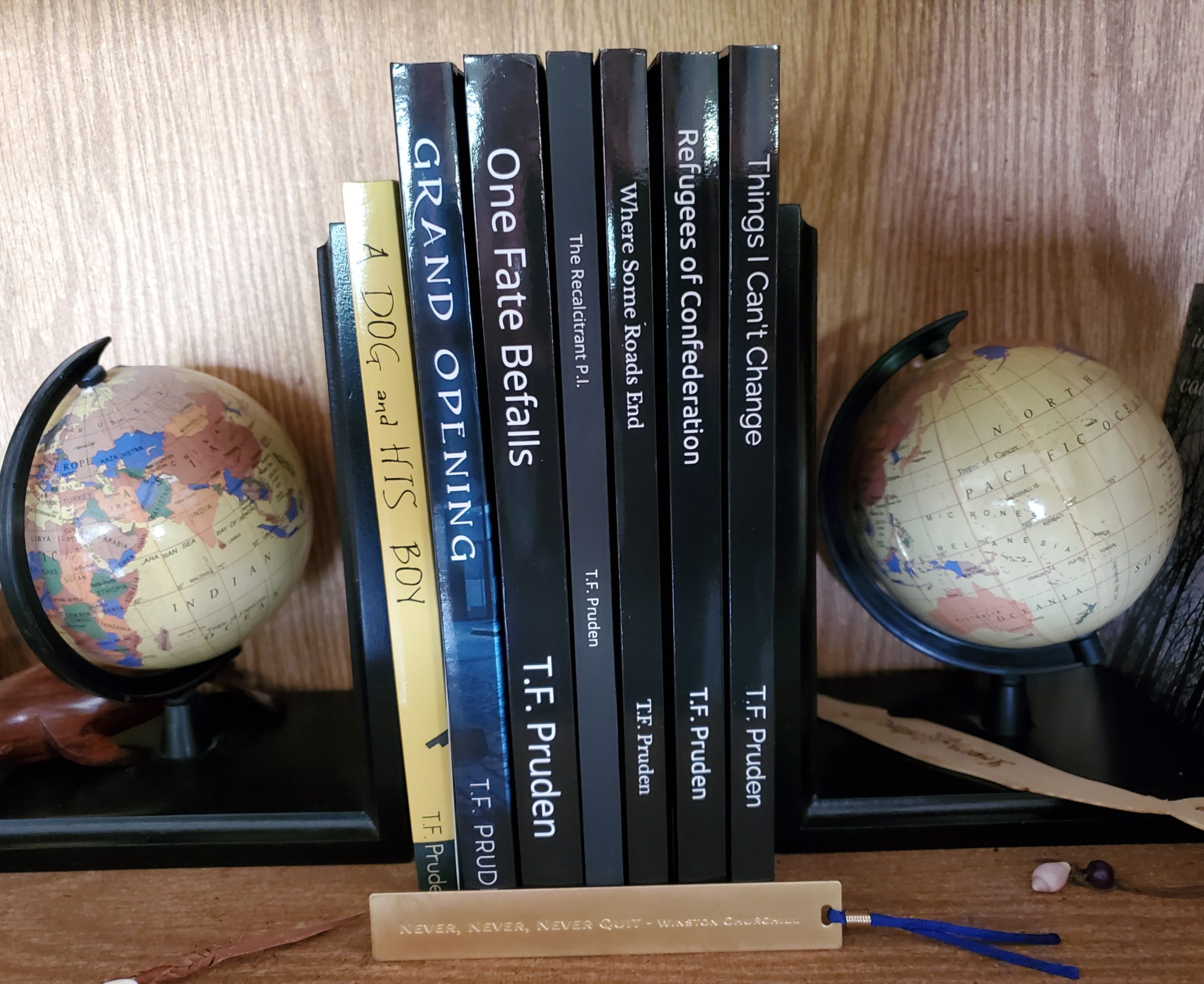
See; to support the emperor’s maxim, I had meant to write about style today. My plan was to discuss use of the active voice and my commitment to it. That and the secrets to reading ease were to feature in this edition of The Practice. I also wanted to share the intricacies of constrained writing and the methods used to create the layered prose featured in my fiction. As usual, I planned to reveal the nuts and bolts that hold my stuff together.

Like most times, however, the best I could do was show instead of tell.

So much for sticking to a plan, I guess. As noted here in the past, digression makes up a large part of what passes for style in these parts.

While granting an often-pedestrian choice of material, its scant literary charm.

And once more, I digress. While digressing that time. So, let’s get back to discussing the craft, gifts, and sharing, shall we?

Truth is, it takes far more than commitment to write. Though none go far without dedication, in fact, it’s the freedom to publish that makes a writer. Call it freedom of expression, or of the press, if you want. Either way, the simple act of publishing one’s private thoughts has always been a far greater danger to those who don’t than to they who do.

I mention that because it hasn’t always been possible for writers to publish. Not even arrival of the printing press assured that freedom. In fact, only after centuries of revolution and the rise of democracy did writers gain the liberty to publish and share their private works with the Western public. As a writer, I’ve received few gifts for which I owe more thanks.

I’ve written before about what a paradise the postmodern world is for writers, but it’s worth a seasonal reminder. For writers, at least in the West, these are the good old days.

Not only that, but with totalitarianism on the rise worldwide, there’s no guarantee the good times will last much longer. Here at home, book bans grow in popularity. While our school standards dive ever lower. Soon, fostered by ignorance, the Western world could once more return to the dark days of the recent past. There, bigotry and hatred were the rule, led by committed groups of fanatics disguised as elected governments.

Think I might kid you? Think again! At this writing, censorship not only lives on as government policy in many parts of the world, but rises once more, right here at home.

These are interesting times indeed.

Now, call me old-fashioned, but I believe we stand at another of history’s countless turning points. For in this moment, the virtual world means our personal choices have the power to affect actual change in the world of tomorrow.

Will we have the courage to turn away from the glorious myths of the hideous past? Do we retain enough collective awareness of the dangers of nostalgia and ignorance to keep them from destroying our world and its freedoms?

I have my doubts, but time will tell. Near as I can figure, only one thing’s sure. It’s going to be a hell of a ride finding out!

As always, this deal is holistic, too. Which means you can’t remove one banana from the bunch without affecting all the fruit left on the tree. So, like it or not, we’re in this thing together, and there’s no place for any of us to go.

Not only that, but many of the same pressures acting on writers are now changing the rules of the world in which all of us live. The drive for profit, the fear of progress, and the demand for increased control over their output mirror corporatist society. In this way, the literary scene serves as a metaphor for the world at large.

Is it not a comfort to know we writers share the same daily existential nightmares as everyone else?

Like many of our twenty-first century troubles, meanwhile, it’s tempting to blame most of it on the internet, progress, and technology. I get that too. I mean, who knew that exchanging convenience and cost for freedom and privacy would end up being so dangerous?

But, you know, life is always a precarious balance of nuance and paradox. And, just like science, just because we don’t notice it doesn’t mean it’s not there.

Of course, I don’t believe the answer to any of these problems will come from asking an AI owned by a billionaire, either. In fact, I believe the longer such an illusion persists, the worse our world’s troubles will become.

After all, is that what we want life to be? Something we throw up our collective hands at and beg for help with from yet another unseen deity? Is that what we’ve decided-without ever knowing we had made a choice-to call progress?

For the record, it’s not the story told in these parts.

Nope. Here, I’m sticking with Marcus. Which reduces the world’s distress to little more than grist for a writer’s mill. In these parts, that will have to do.

Because just as the man said, what stands in our way must become it.

And what’s the moral of this seasonal tale?

Well, I thought either: “Life is change, and time is short, so act now.”; or “It’s a hard ride, and every shot counts.” might work. But it could also be, “Seek wisdom because even a fool’s choices echo through time.” though none of them recalls the season.

Of course, the favourite around here is, “Might as well laugh at yourself now because later everyone will.”

Truth is, though, I’ve never been much for closing doors. Either real or imagined. That could also be why, as the routine goes in these parts, I let the writing speak for itself and leave the moralizing to you, reader.

So, there you go-live it up!

How’s that for spreading a little noir cheer for the holidays?

Thanks for being here, and for sharing this with anyone who might like to read it.

– TFP

December 13, 2025

Methods and plans.

But all good things must end, and so my summer of fun, disguised as work, is done.

The crisp edge in the September morning air soon enough clears up my view of the world, and me, too. Even for a hard-shelled nut, most times, it’s a sobering picture.

Hello reader, and welcome.

Thanks, too, for dropping by. Though it’s been a minute, you can’t miss me if I don’t make a habit of going away.

Of far greater concern is my being here too often. For I know too well how familiarity breeds contempt.

Likewise, I understand that cost defines value. Thus, the act of giving something away without charging a fee soon enough renders that item worthless. As a result, I spent the last few months thinking over pay-per-view options for future editions of The Practice.

To no one’s surprise, there are now places (Medium, Patreon, Substack, etc.) that make paywalls and give subscriber-only access to stuff much like this for writers. My review of them continues.

Of the answers proposed to date, discontinuing The Practice leads. So, with the future unclear, I suggest enjoying this one.

You’re welcome to weigh in on this, too. Email and let me know what you think about pay-per-view access to this type of writing. Would you pay a one-time or recurring fee to read The Practice if it were behind a paywall? Why or why not? Thanks for sharing your thoughts.

Meanwhile, I’m back, and away we go.

Despite the exciting and productive summer, I enjoy fall best.

Now, I can only pine for warm afternoons spent working with friends in the sunshine. After all, between making music on stage and shooting film on the street, it was about as much fun as I’ve had, with boots on my feet.

But all good things must end, and so my summer of fun, disguised as work, is done.

The crisp edge in the September morning air soon enough clears up my view of the world, and me, too. Even for a hard-shelled nut, most times, it’s a sobering picture.

Of course, with the change in season, my respite from the keyboard also nears an end. Soon, for better or worse, I must return to my chosen life as a writer of novels.

So, to ease my return to the daily grind of writing fiction, I’m sharing a few thoughts on the writing craft with you today. Between the usual confounding digressions, that is. Lest we forget, the meandering nature of my prose composes much of what passes for literary style in these parts.

How’s that for irony at arm’s length?

Truth is, over the years, I have perhaps sacrificed as much to form and style as any other aspect of my practice. And though I mean no offense, reader, what is the point of writing if not to please its writer? Here, despite the popular failure of my efforts to date, I believe the work of making this brand of non-traditional Indigenous literature must continue.

This, despite learning that, after disappearing for a decade, the man from Harwill still commands more for a night on stage than my novels earn in a year.

Well, despite the obvious trouble posed by that sorry fact, I’m no less committed to staying the course. For reasons other than health or money, too.

Because, and lucky for me, success, like spacetime, is relative.

Not only that, but my desire to write and publish novels that challenge the literary status quo still outweighs all else, including either need or want. What’s more? I live better staying away from the many things that might prevent me completing them, too.

And yes, the longer I work at writing, the happier I am with the results. Sadly, the numbers tell me that so far, I can’t say the same for you, reader.

Oh well. The work of creating a literary frame of reference that shows how it was for a group of people forgotten by history, who yet helped shape certain moments during always uncertain times, maintains its strange hold over me. I remain compelled to write these stories.

For there, I believe, is the actual method by which the sum of a whole might exceed that of its parts. Likewise, the true proof for evolution is how changing moral standards always provide the rules for tomorrow’s society. Though not the only reasons, to me those are important aspects of what makes writing about us worthwhile.

Like many who write, reader, I too have an agenda. Mine is challenging yours. I believe that’s how writers contribute to the process of evolution.

Despite the lofty aim, and though grounded in realism and based on experience, my novels are pure fiction. Like most works of this type, they’re entertainments, but reflect the philosophy and expose a worldview held by their author. For I believe, too, that only books that do are worth reading.

Their writers, meanwhile, should ever linger on the outskirts of memory, either dead or living as anachronisms. These days, I count myself among the latter.

Did you note the ease with which I digressed there? Is that style? Or a hint of something more nefarious?

Let’s get back to our craft talk.

The first, and perhaps only, strict rule for learning how to write is to read a lot. To be a writer, you must first read. Books are, after all, the how-to manual of writing. From there, in spirit if not practice, you’re on your own.

The second one is big, too.

This writing thing is a solo deal. Did I mention that? Well, if not, there you go. A writer must spend most of their time alone. When writing, of course, but also while not writing, too.

Aloneness is a skill, you see, and like any other, you both acquire and improve it with practice.

For a writer must learn to see the world with their own eyes.

By now, I believe the in-between times are far more important than the hours spent at the keyboard, too. Though I’ve also learned discipline is key to everything, not just writing. That’s why I stick to methods and plans, while ignoring the ebb and flow of desire and inspiration.

Despite beginning this flight, as did many before me, with only the seat of my pants. If that works for you, keep on keeping after it. If it doesn’t, find another way. In the internet age, information abounds.

See, I believe the thing called a writer’s voice comes from life. And while desire and intent help, a cook needs the right stuff to make soup, too. Thus, a big part of a writer’s job is making sure they’ve lived enough to gather the proper ingredients for the meal they plan to serve.

Recall, too, that much like a cook, a writer improves by practice. So, if the souffle falls, or your latest story gets rejected, try again! Refuse to quit. Teachers of writing call that process finding your voice.

Given enough living, practice, rewriting, sweat, tears, and time, if one lives in you, you’ll grow into it. Though what you discover may not be what you hoped for when the search began. As many writers learn, the life seldom lives up to the dream.

Here, I write when I’m writing. I call it the training-camp approach. As much as possible, I live during the time of a novel until done writing it, too. And while in camp, I see few people, and seldom if ever speak about the work. I instead rely on the strict discipline of a six-day-per week routine, with early mornings spent working at a desk with my laptop, followed by exercise, and Sundays off. A perpetual soundtrack plays at low volume in the background. To avoid unwanted influence, I don’t read fiction during the time I’m writing. Instead, I watch plenty of movies and, if in season, baseball on television. I augment the simple plan with a healthy diet, and get plenty of rest, too. Then, for the months and weeks needed to write or rewrite or edit a draft of a novel, my calendar is full. I’m not a complete whack job, though, and remain in the present when not working.

That process provides for me and my abundance of psychoses. But years of practice went into discovering those methods. So, I encourage writers to start young and take plenty of time to figure out what’s best for themselves.

I spent decades working at other things while learning to write novels.

Not only that, but when I started out, pulp fiction was the writing to which I aspired. A career writing paperback novels is what I wanted. I figured on writing what I liked to read, and in those days, that was cowboy and detective stories. To me, it looked but a short step to the bestseller lists.

Then stuff like high school and puberty arrived, and most everything, including writing, changed for me. Along with chasing girls and playing sports, came awareness of myself and the place my family and I occupied in the world. Though I didn’t know it then, writing a fictional version of that place and its people would grow into the genuine passion of my lifetime.

How am I doing with the craft talk? Are the ideas clear enough to make sense to you? Or have I strayed too far into the obscure once again? Maybe ‘as usual’ is a better choice? I am, after all, a master of the oblique reference.

You’ll have to let me know.

As ever, I’m too easy to find, but email is best if wanting a reply. For now, it’s almost time to wrap up our writing chat.

This next thing is most important, no matter what your level of desire or experience. It applies regardless of genre, talent, or skill besides.

All good writing is rewriting. Those who wish it otherwise aren’t writers. If rewriting a sentence a few dozen times doesn’t bring you great joy, it’s not your bag.

In short, if you can’t live without doing it, you’re a writer.

Now here’s a personal insight, using the egghead-speak you won’t find in my books.

My novels use an outsider’s perspective defined by Metis heritage, combined with literary techniques including constrained writing, minimalist prose, noir humor, and realism to explore the impact of moral relativism among the post-colonial peoples of western Canada. Each of them challenges the prevailing historic narrative by sharing visceral portraits of unreconciled aspects of postmodern life. For in the twenty-first century, I believe only as an outsider, a minority among minorities, and a man without a country, is a writer freed from the ever more severe limits imposed by censorship and decorum.

Some folks might call that an artistic statement. I think of it as the writer’s manifesto. See, along the way here, I came to believe a writer’s actual job is showing how it was. I also consider fame, fortune, and popularity as not intrinsic to the métier.

How’s that for a frame of reference?

There’s always more, but for now, I’ll stop. The way I figure it, that’s plenty, but not more than a reader can digest at one sitting. While a writer, of course, will suggest edits. And, like I said before, enjoy this as the last of these, for at least a while.

Because it’s time to get to work on the second draft of my ninth novel.

Thanks again for being here, and for sharing this with anyone who might like to read it.

TFP

September 20, 2025